

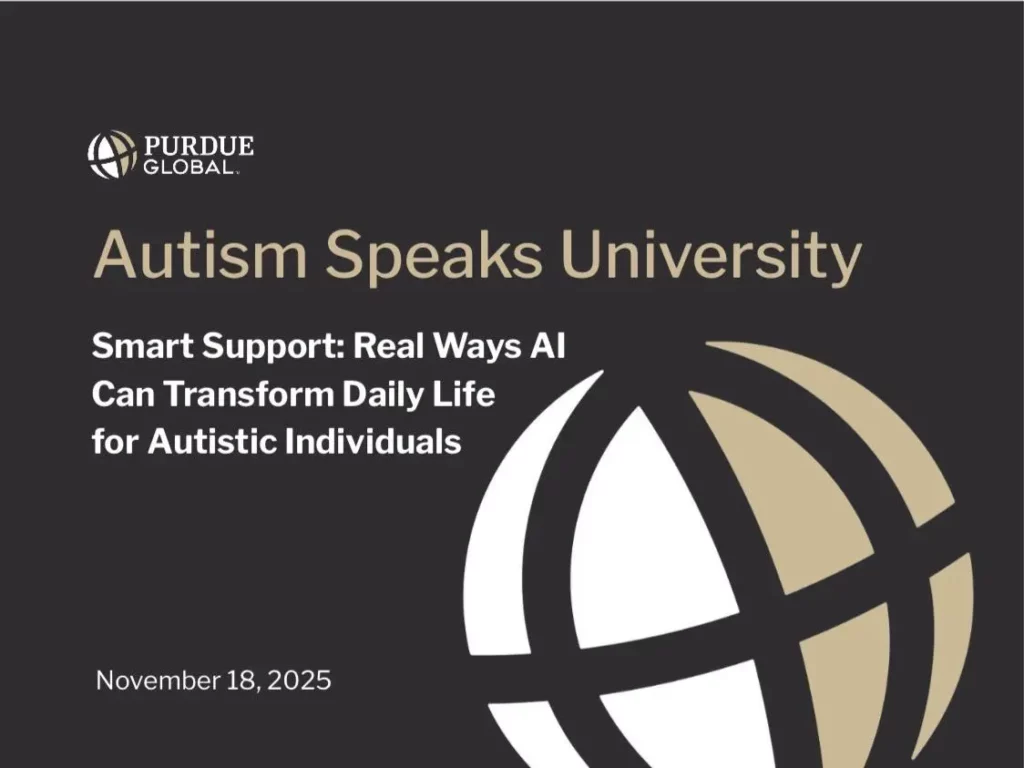
In today’s world, where artificial intelligence is increasingly influencing our everyday lives, including decisions and support systems; designing technology that is both reliable and human-centered has become all the more important. This understanding of thoughtful and compassionate innovation took center stage during Autism Speaks University’s recent webinar held on Tuesday, November 18th. The webinar’s topic was, “Smart Support: Real Ways AI Can Transform Daily Life for Autistic Individuals,” which was hosted by ASU’s President Lestine Grace Saquilabon, the chapter officers, and ASU Advisor Shannon Weiss. The event was organized as a collaboration between Ascend Ventures and Autism Speaks University (ASU) of Purdue Global, reflecting a shared mission toward empowering autistic individuals through technology, support, and accessible resources.
As part of this collaboration, Ascend Ventures announced its commitment to donate $1000 every year starting November this year to help further community engagement, online advocacy, and programs that directly benefit the autism community.
This initiative reflects the vision of Vasanthan Ramakrishnan, Founder & Principal Investor at Ascend Ventures, who has been a consistent advocate for using innovation and investment to drive meaningful social impact. Speaking about the partnership, Vasanthan shared:
“Technology should expand human possibilities, not replace them. When thoughtfully built, AI can bring structure, calm, and dignity into people’s lives, especially for autistic individuals who rely on clarity and predictability. Our partnership with Autism Speaks University is a step toward making that vision real.”
The event featured a series of speakers dedicated to reimagine how supportive technology can help autistic individuals in their daily life. Among the evening’s highlights was the presentation titled “From Banking Systems to Breakfast Routines: How AI Can Support Daily Independence,” delivered by Senthil Nathan, Vice President at JP Morgan. With more than 25 years of experience building AI-powered payment systems, Nathan presented a refreshingly grounded perspective on how the same principles that protect global financial transactions can guide daily routines for autistic individuals seeking greater autonomy.
A Leader Who Bridges High-Stakes Technology and Daily Human Needs
Senthil Nathan’s career has centered on building secure, reliable, AI-assisted payment platforms that move billions of dollars across nations every day. In such systems, accuracy and predictability are not optional, but are essential. A single error can affect a person’s ability to pay bills, buy groceries, or access essential services.
The core of his work, Nathan explains, has always been trust, built through “reliable, predictable, and trustworthy” systems designed to protect individuals’ financial well-being.
His influence stretches far beyond corporate technology, where Nathan guides the next generation of innovators. As a dedicated STEM advocate, robotics coach, and national competition judge, he mentors high-school students in computer science and engineering. This dual lens, enterprise-scale expertise and community-focused mentorship, shapes his unique approach where his goal is to design AI that adapts to individuals with autism rather than forcing such individuals to adapt to technology.
Finding Common Ground: Banking Pipelines and Morning Routines
At first glance, global banking systems and a child’s morning routine appear to share little in common. But Senthil Nathan challenges this assumption through a compelling analogy.
In banking, money moves through a series of steps, like validation, enrichment, qualification; each meticulously engineered to function in a clear and sequential order. A disruption at any step brings uncertainty and stress for the customer.
Nathan then extends this framework to a typical morning routine many autistic individuals experience, for instance, brushing teeth, packing a backpack, eating breakfast, and preparing for school or work. Each routine, he emphasizes, is also a sequence of dependent micro-steps, and unpredictability at any point can trigger elevated stress, overwhelm, or shutdowns.
“We all want to know: What am I doing now? What am I going to do next? Did I complete this step?” he notes. For autistic individuals, this need for predictability is magnified, making clarity essential rather than optional.
Just as AI provides smooth, confident financial transactions, Senthil Nathan believes AI can gently guide individuals through daily routines in a way that promotes calm, clarity, and control; without ever undermining autonomy.
Three Core Design Principles for Assistive AI
From decades of experience developing secure digital infrastructure, Nathan outlines three foundational design principles that should guide any responsible assistive AI for autistic individuals.
1. Predictability: Reducing Stress Through Step-by-Step Clarity
Whether tracking a package through the postal service or a payment through a bank, people feel reassured when they can see what is happening now, what will happen next, and when the entire sequence is complete.
Nathan argues that assistive technology should provide the same assurance. AI can break down routines into simple, digestible steps with clear indicators of progress, reducing anxiety and helping individuals feel more grounded in their daily tasks.
2. Transparency Through Gentle Nudges Instead of Commands
The second principle is “transparency”, that focuses on how AI communicates instructions. Rather than issuing controlling directives like “Do your homework now,” AI can guide users through contextual, supportive reminders, such as, “You usually start homework after lunch” or “You tend to focus best when you take a short break.” These subtle prompts encourage self-initiation and decision-making, cultivating independence instead of dependence.
Nathan stresses that the goal is support, not control. When AI adopts a kind tone and explains the “why” behind its suggestions, users feel empowered rather than managed. This approach also builds trust, which is an essential part of long-term engagement with any assistive tool.
3. Safety and Privacy: Non-Negotiable Foundations
Coming from the world of banking, Nathan is unyielding about privacy. He firmly stands by the idea that sensitive information should never be shared unnecessarily. He states that personal routines should remain on-device, not sent to cloud servers. He also highlights the point that users should always know they are operating in a safe, non-surveilled space.
“Privacy is completely non-negotiable,” he emphasizes, advocating for systems that personalize support without collecting or transmitting sensitive data to remote servers.
This standard supports assistive technologies to remain tools of empowerment, not tools of monitoring.
Toward a Future Where AI Creates Calm, Confidence, and Control
In both banking and daily life, Senthil Nathan ties his message together with a simple framework, trust + clarity = confidence, and confidence leads to independence.
To build assistive tools that truly uplift autistic individuals, technology must be:
- Simple, not overwhelming
- Consistent, not unpredictable
- Kind in tone, not commanding
- Empowering, not directive
- Fair and secure for every user
When AI is grounded in these values, it becomes more than a digital tool. It acts like a steadying companion that guides individuals to manage their routines with assurance and autonomy.
In his closing remarks, Nathan underscores that whether one is designing billion-dollar systems or supporting a ten-minute morning routine, the underlying principle remains identical: Trust is the engine that powers both.
Through continued collaboration, such as the one between Ascend Ventures and Autism Speaks U, and with leaders like Vasanthan Ramakrishnan driving long-term commitments, including annual financial support, the future of assistive AI stands to become more compassionate, accessible, and empowering for autistic individuals everywhere.
